Planting the Flag: A Timeless Obsession of Humankind
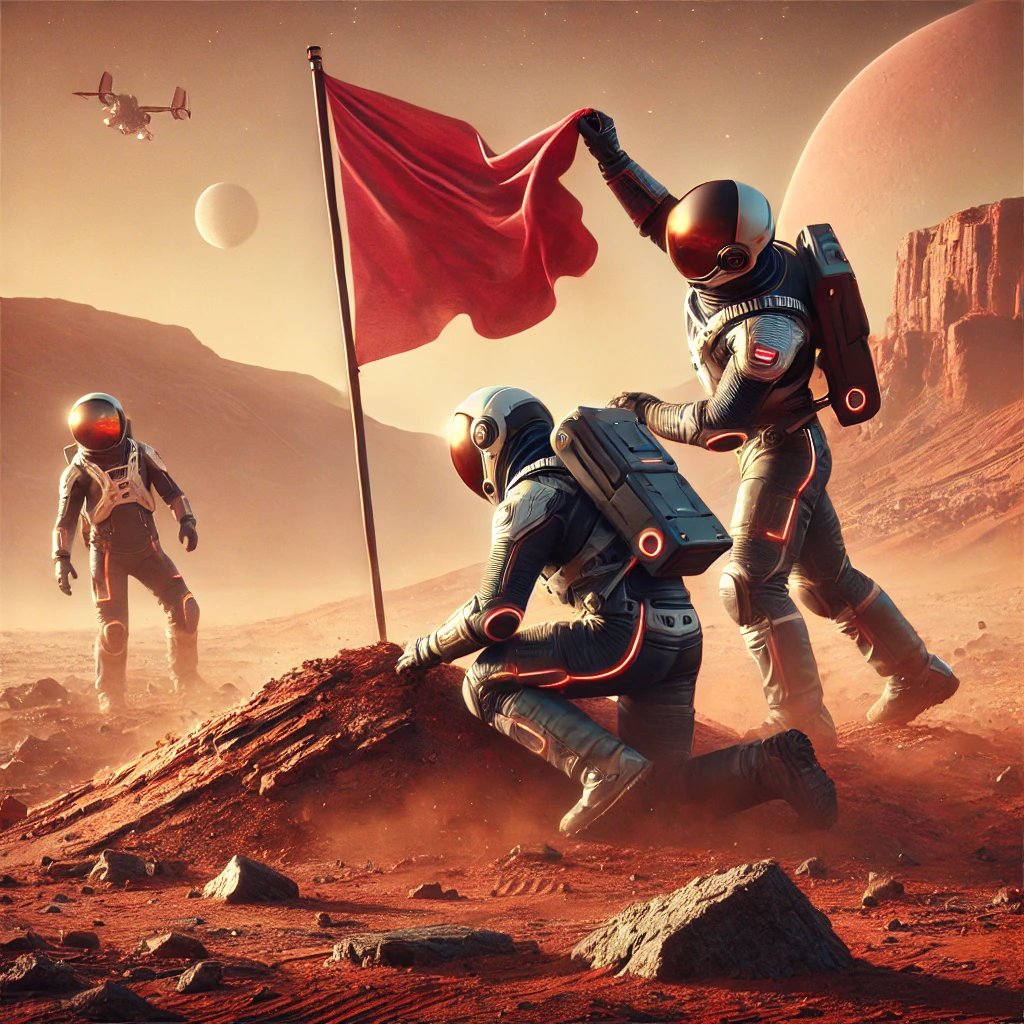
If there’s one thing humans love more than claiming things, it’s making sure everyone knows we’ve claimed them. From the dusty prairies of the American West to the barren craters of the Moon, we’ve left no stone un-stuck-with-a-flag. And now, the United States wants to bring this time-honored tradition to the red soil of Mars. But why are we so obsessed with jamming a piece of fabric on a pole into the ground and declaring victory?
10/20/20253 min read
The Historical Urge to Stake a Claim
Let’s start with the basics: flags are a symbol of dominance. They tell everyone, “This is ours now,” whether “this” is a pristine mountaintop, an icy tundra, or just a particularly nice spot on the Moon. In the 15th and 16th centuries, European explorers planted their flags on every coastline they could find, often ignoring the inconvenient fact that people were already living there. Fast-forward to the 19th century, and American settlers were driving stakes into the western frontier like it was a competitive sport, culminating in the Land Rush of 1889, where planting your claim before the gun fired was considered poor form.
The Psychology of Flag Planting
But why a flag? Why not, say, a rock or a signed note? Psychologists argue it’s all about symbolism. A flag is portable, colorful, and unmistakably human—it’s our version of a lion’s roar or a bear’s claw marks. It’s an assertion of identity, a public display of ownership that says, “I was here first (or loudest).”
This primal urge to mark territory isn’t limited to Earth, of course. The race to the North and South Poles in the early 20th century wasn’t just about frostbite and glory; it was about being able to plant a flag at the literal ends of the Earth. Similarly, when Sir Edmund Hillary and Tenzing Norgay summited Everest in 1953, they didn’t just take in the view—they whipped out flags for New Zealand, Nepal, and the United Nations.
Flags in the Space Age
And then there was the Moon. On July 20, 1969, Neil Armstrong and Buzz Aldrin famously planted the American flag on the lunar surface, a move so iconic it became shorthand for humanity’s greatest achievement. But here’s a fun fact: the flag isn’t waving in the cosmic breeze; it’s supported by a horizontal rod because, surprise, there’s no wind on the Moon.
This act wasn’t just about science—it was a geopolitical mic drop in the context of the Cold War. The message was clear: the United States had outpaced the Soviet Union in the space race.
The Martian Ambitions
Now, as NASA and private companies like SpaceX eye Mars as humanity’s next frontier, the flag-planting tradition seems inevitable. But what does planting a flag on Mars mean in 2025? Is it an act of exploration, a testament to human ingenuity, or simply a modern flex in interplanetary politics?
According to international law (yes, there are laws about space), no country can claim celestial bodies as their territory. The 1967 Outer Space Treaty explicitly forbids sovereignty on the Moon, Mars, or anywhere else beyond Earth. But that doesn’t mean planting a flag is off-limits—it just makes the gesture more symbolic than legal.
Humor in the Quest
Of course, there’s something inherently amusing about the idea of dragging a flagpole millions of kilometers through the void just to stick it into Martian soil. What happens if it gets stuck? What if the wind blows it over (yes, Mars has wind)? And what if, in the distant future, Martian colonies decide they prefer a different flag entirely?
The Bigger Picture
At its core, the act of planting a flag represents humanity’s need to explore, claim, and connect. It’s a way of saying, “We were here, and we mattered.” Whether on Earth, the Moon, or Mars, a flag isn’t just a piece of fabric—it’s a statement of ambition, unity, and, let’s face it, a touch of competitive spirit.
So as the United States prepares to aim for Mars, one can only wonder: What kind of flag will it be? A redesigned Old Glory? A sleek NASA logo? Or perhaps, in the spirit of international cooperation, something representing all of humanity? One thing’s for sure: when we finally plant it, it will flutter in the thin Martian breeze—or at least in our imaginations.
And let’s hope the aliens are okay with that.
Itineround
Discover itineraries and maps of world cities.
email - itineround@gmail.com
© 2026. All rights reserved.