Monsters and Legends: The World's Most Famous Cryptid Destinations
Few things captivate the imagination like a good monster story. From misty Scottish lochs to dense Himalayan snowscapes, the legends of cryptids — those elusive creatures of folklore and rumor — have fueled countless expeditions, grainy photographs, and hushed fireside tales. But what is it about these mysterious figures that draws so many travelers to their alleged habitats? And more intriguingly, why do these monsters seem to have an uncanny knack for dodging their admirers? Pack your binoculars and let’s dive into the world’s most legendary monster hotspots, complete with practical tips (and a touch of humor) for aspiring cryptid-spotters.
10/15/20253 min read
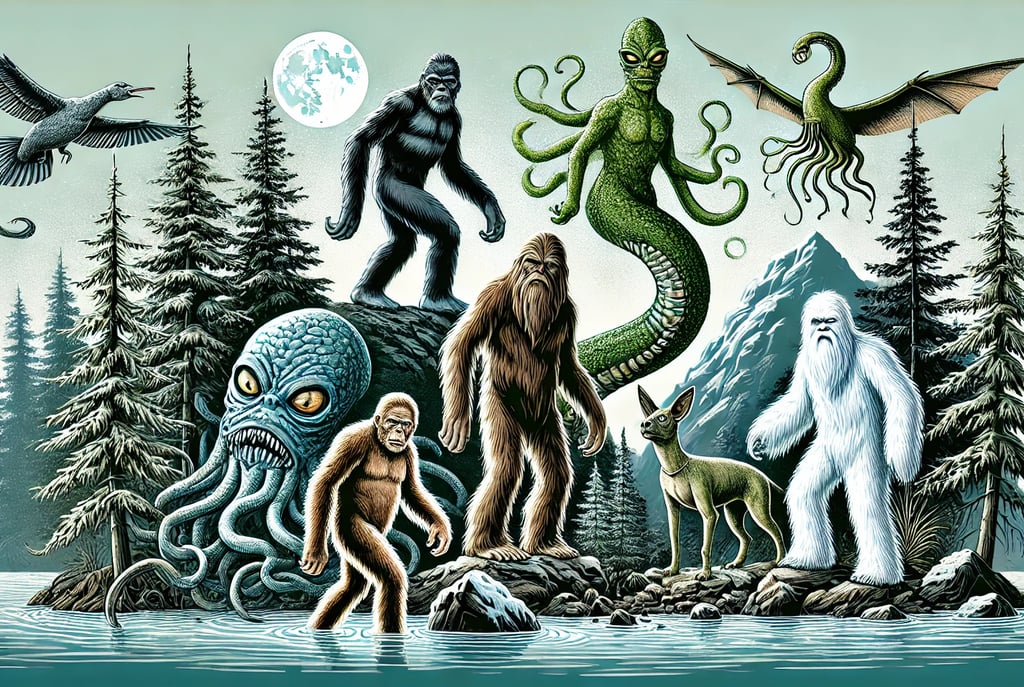
1. The Loch Ness Monster — Scotland
The grand dame of cryptids, Nessie, reigns supreme in the chilly waters of Loch Ness, a 23-mile-long freshwater loch nestled in the Scottish Highlands. Tales of a serpent-like creature date back to the 6th century, but it was a grainy 1934 photograph, dubbed the "Surgeon's Photograph," that catapulted Nessie to international stardom.
Today, Loch Ness is a pilgrimage site for monster enthusiasts and hopeful photographers. To increase your chances of spotting Nessie, visit during early mornings when the loch’s surface is eerily still. Pro tip: Bring a drone or book a boat tour—monsters, like celebrities, tend to prefer privacy but might tolerate paparazzi from a distance.
Of course, Nessie sightings are rare, but locals joke that she’s simply shy. "She’s on holiday," one boat operator told me, "or she’s stuck in traffic at the bottom of the loch."
2. Bigfoot — Pacific Northwest, USA
Known as Sasquatch to Native American tribes, Bigfoot has been stalking the dense forests of the Pacific Northwest for centuries. Descriptions vary, but the essentials remain the same: a hulking, hairy figure with enormous feet and a penchant for avoiding high-definition cameras.
To maximize your chances, head to Washington State’s Olympic National Forest or Oregon’s Mount Hood. Seasoned hunters recommend nighttime stakeouts armed with snacks (Bigfoot reportedly has a sweet tooth) and a strong pair of boots. You’ll need them for the endless hiking.
Why hasn’t Bigfoot been caught yet? Theories abound, ranging from interdimensional travel to a highly developed instinct for social distancing. Or perhaps Bigfoot’s just an introvert who’s perfected the art of ghosting.
3. The Yeti — Himalayas
The Yeti, or Abominable Snowman, haunts the snowy slopes of the Himalayas. With reports of giant footprints and distant howls, the Yeti’s legend has inspired everything from mountaineering expeditions to Disney movies.
For the best shot at an encounter, book a trek to Nepal’s Everest Base Camp or Bhutan’s remote Phobjikha Valley. Sherpas are often your best guides, as they know the terrain—and the stories—better than anyone.
But a word of caution: Yeti hunters risk frostbite, altitude sickness, and disappointment. One climber told me, "I didn’t see a Yeti, but I did see my guide’s lunch disappear. Draw your own conclusions."
4. The Chupacabra — Latin America
The Chupacabra, a blood-sucking creature said to prey on livestock, emerged from Puerto Rican folklore in the 1990s. Descriptions vary: some say it resembles a reptilian kangaroo, while others compare it to a mangy dog.
Puerto Rico remains the Chupacabra’s spiritual home, though sightings have spread as far as Mexico and Texas. Farmers and ranchers are your best source of intel, and if you’re really lucky, you might hear firsthand accounts of "the night the goats screamed."
Chupacabras may not play hard to get so much as they play hard to identify. Are they monsters? Wild animals with a PR problem? Or simply misunderstood vegans unfairly blamed for a few missing chickens?
5. The Kraken — Nordic Seas
No list would be complete without the Kraken, the gargantuan sea monster of Norse mythology. Though commonly dismissed as a sailor’s tall tale, modern researchers suggest the legend could be rooted in sightings of colossal squid—real creatures that can reach up to 43 feet in length.
For Kraken enthusiasts, Norway’s Lofoten Islands and Iceland’s black sand beaches are the places to be. Whale-watching tours sometimes offer a tantalizing glimpse of enormous tentacles beneath the waves.
Skeptics may scoff, but seasoned mariners warn: if you see the water bubbling ominously, it’s either the Kraken or someone forgot to turn off the jacuzzi.
Why We Chase Monsters
What drives people to spend time, money, and vacation days chasing after creatures that may or may not exist? For some, it’s the thrill of the hunt. For others, it’s the allure of mystery in a world increasingly mapped and digitized. Monsters offer a taste of the unknown, a chance to believe in something bigger (and scarier) than ourselves.
As for why monsters elude us, theories range from practical (they don’t exist) to philosophical (they’re metaphors for our fears and desires). Or maybe they’re just laughing at us from their secret lairs, sipping cocktails made from our dashed hopes.
Tips for Aspiring Cryptid Hunters
Do Your Research: Learn the local legends and history. Knowing what to look for (and where) is half the battle.
Bring Gear: A good camera, sturdy boots, and a healthy dose of skepticism are essential.
Talk to Locals: They often have the best stories and tips—and occasionally, homemade maps.
Keep an Open Mind: The real treasure might not be spotting a monster but the adventure itself.
Be Respectful: To both nature and the creatures (or lack thereof) you’re seeking.
So, are you ready to book your monster-hunting expedition? Whether you come face-to-face with Nessie or just a suspiciously large fish, one thing’s certain: you’ll walk away with a story worth telling. Just don’t forget to send the monsters a courtesy email. They’re busy, you know.
Itineround
Discover itineraries and maps of world cities.
email - itineround@gmail.com
© 2026. All rights reserved.